Asset management
Like many foundations, the Foundation for Baltic and East European Studies has a perpetual investment horizon. The original endowment shall be managed in a manner that preserves, at a minimum, its real value over time. Furthermore, the Foundation’s assets shall be managed prudently, balancing controlled risk-taking with the objective of generating attractive long-term returns. The Foundation’s Board has adopted an investment policy that serves as a framework and guiding principles for managing the Foundation’s capital. The policy is reviewed annually.
The Board has adopted an annual long-term real return target which, as of 2026, amounts to 3.5 per cent. The Board also adopts, on an annual basis, a strategic reference portfolio, specifying allocation levels across asset classes as well as permitted deviation ranges.
The following principles are guidelines for the asset management:
- The Foundation for Baltic and East European Studies has a perpetual investment horizon, enabling the Foundation to invest with a long-term perspective and thereby benefit from advantages relative to more short-term investment strategies.
- The Foundation’s assets significantly exceed the endowment capital (which may not be depleted), allowing the portfolio to include investments with relatively higher expected volatility — but attractive risk-adjusted return characteristics — such as equities.
- Diversification across and within asset classes is essential in managing overall portfolio risk.
- In order to achieve the long-term return target, the Foundation’s asset portfolio must contain a balanced allocation within assets, including equities, real estate and corporate credit.
- Low portfolio turnover and cost-efficient management contribute positively to long-term net performance.
- The resources within the investment organisation are limited and must therefore be deployed efficiently.
- The Foundation’s investment philosophy includes a responsible ESG framework, aimed at limiting potential financial consequences associated with ESG-related risks while simultaneously contributing to a sustainable society and environment.
The Board retains the ultimate responsibility for the Foundation’s asset management and governs the overall framework through the adopted investment policy. On the Board’s behalf, the oversight of the asset management is delegated to an investment committee, which convenes on a monthly basis. The Foundation employs internal portfolio managers which manages the Foundation’s assets on a day-to-day basis. The Swedish Legal, Financial and Administrative Services Agency serves as the Foundation’s back office and middle office functions. Alongside the regular audit, the asset management is also reviewed by an external party on an annual basis.
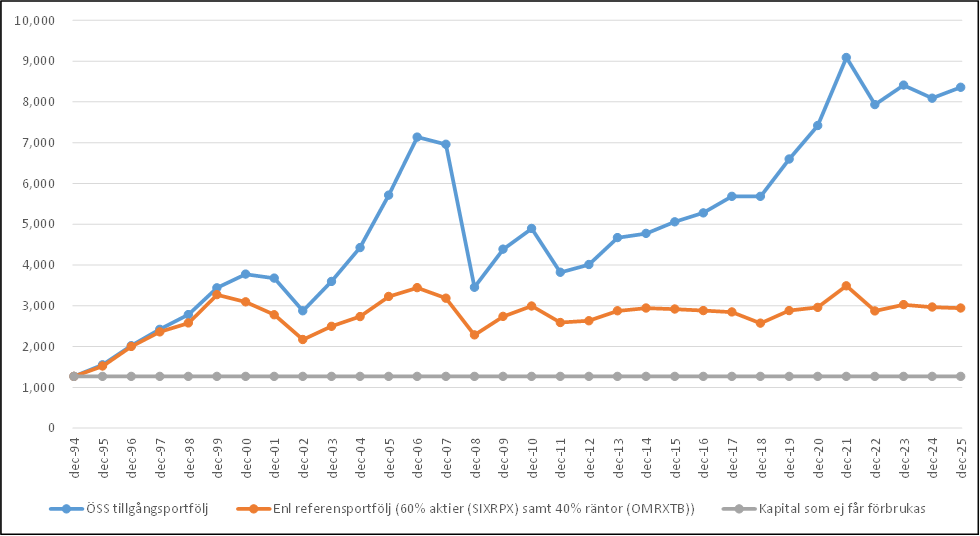
At the Foundation’s inception in 1994, it was allocated an endowment of SEK 1,270 million. From inception, through 31 December 2025, the Foundation has generated an average annual return exceeding 9.5 per cent (real return 7.7 per cent). During this period, SEK 5,1 million has been distributed in grants.
The chart below illustrated, in blue, the Foundation’s actual development from inception through 31 December 2025. The orange line represents a reference portfolio consisting of 40 per cent bonds and 60 per cent equity, while the gray line represents the assets that may not be depleted.